
FOR IRISH ON-TRADE OPERATORS
Your cocktail list trained your guests to spend €15 a drink.
What did your wine list do tonight?
A diagnostic for venues where the cocktail programme has grown up — and the wine programme hasn't kept pace.
Gavin Keogh, Beverage Programme Consultant
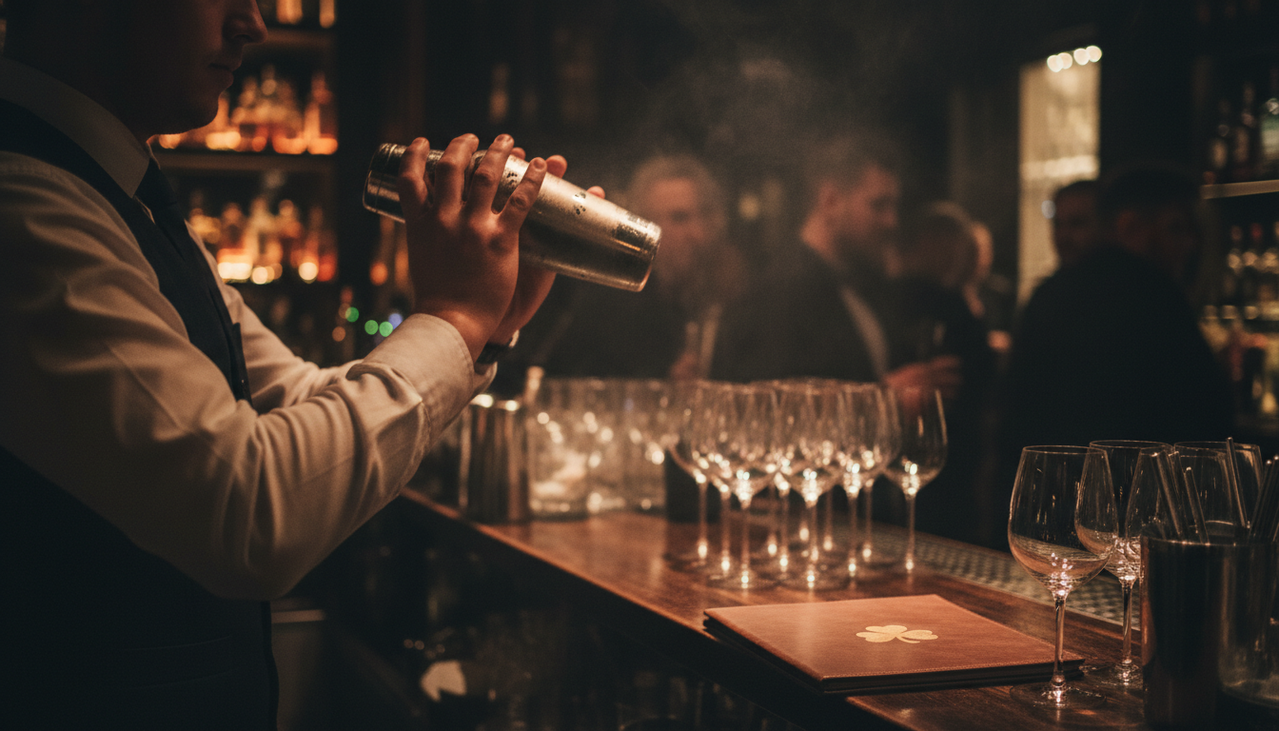
Your cocktail list trained your guests to spend €15 a drink.
Craft cocktail culture taught drinkers to trust a well-designed list and pay accordingly. Here's how to apply the same structure, pacing, and storytelling to your wine list — and lift GP without lifting a finger on stock.
€15+
Average cocktail spend per serve in the UK on-trade (Lumina Intelligence, 2025)
3–4 min
Time to build one craft cocktail — versus 25 seconds to pour a glass of wine
75%+
Achievable GP on wine by the glass in Irish city-centre venues (Irish Times, 2026)
THE PROBLEM
The wine programme that time forgot
There is a recognisable pattern in Irish hospitality. A venue builds a strong cocktail identity — great list, trained staff, premium glassware, seasonal specials. The bar team know every spec. The GM is proud of the programme. Regulars come specifically for it.
And then someone orders a glass of wine.
What arrives is a house white in a thin glass, poured from a bottle that's been open since Tuesday, described by the server as "it's dry, I think" — and priced at €9.50. The guest smiles politely and decides not to order another.
This is not a small problem. It is a structural revenue leak that compounds across every service, every week, every year. And it happens specifically because the cocktail programme absorbed all the attention, all the training, and all the investment — leaving the wine programme running on inertia.
A cocktail-forward venue without a serious wine programme is a car with a high-performance engine and flat tyres on two wheels.
This document is not a general argument for wine. It is a specific diagnostic for venues where cocktails have become the identity — and where wine has quietly become the gap in the floor that's costing real money.
THE DIAGNOSIS
What a neglected wine programme actually looks like
Operators rarely neglect their wine programme intentionally. It happens gradually. The cocktail list gets a seasonal refresh; the wine list stays the same. A new bartender joins and gets two weeks of cocktail training; nobody mentions the wines. The GP meeting focuses on spirit margins. And slowly, the wine programme stops being a programme at all — it becomes a default.
The seven symptoms
A neglected wine programme tends to show the same symptoms regardless of venue type. Here is what to look for:
Symptom
What It Signals
What It Costs
House wine priced at €8–€10
No confidence in the product; commodity positioning
Every wine order lands at the floor — not the ceiling
Wine list shorter than the cocktail list
Wine is an afterthought, not a programme
Guests default to cocktails or beer by design
No descriptions on wine menu
Staff can't sell what they can't explain
Upsell rate collapses to near zero
Same list for 12+ months
No curation, no seasonal rotation, no excitement
Repeat guests have no reason to explore
Staff default answer: "it's dry / fruity"
Zero training investment in wine
Guest confidence in the programme is zero
Wine opened and not tracked
Spoilage eating undetected into margin
Waste compounds every week
No wine recommendation at table
Wine is invisible in the service sequence
Cocktail is the default for every spend decision
Almost half of UK wine drinkers are interested in trying new and different wines regularly — but only when given the opportunity.
— CGA / Bermar Wine Programme Research, 2024
The missed conversation
The most telling sign of a neglected wine programme is not on the list — it is in the service sequence. In a venue with a strong cocktail identity, staff are trained to open with cocktail recommendations. The pre-dinner conversation is cocktail-led. The aperitif round is cocktail-led. The dessert round might be cocktail-led.
Wine never gets a moment in that conversation — because nobody has given staff a reason to give it one. The guest who would happily spend €14 on a well-described glass of Picpoul or an interesting natural red from the list never gets asked. They default to a cocktail they already know, or they order the house white because it is the path of least resistance.
This is not a guest preference problem. It is a service design problem.
VENUE PROFILES — THIS IS YOU
Three venues. The same diagnosis.
The neglected wine programme appears in different forms depending on the venue. The cocktail bar that started serving food, the restaurant bar with a brilliant bar team, and the hotel bar with a seasonal cocktail menu — each has its own version of the same problem. Here is how to recognise it.
Venue Type 1: The Cocktail Bar That Added Food
The bar came first. The kitchen was added later. Wine was never part of the original identity.
What this looks like in practice:
The cocktail list runs to two pages with seasonal specials; the wine list is half a laminated sheet
The kitchen team pair dishes with cocktail suggestions — nobody has ever matched a wine to the menu
Wine was sourced reactively when food launched and has never been revisited
Bar staff are exceptional cocktail makers and genuinely uncomfortable being asked about wine
The guest who orders wine at the bar gets a slightly apologetic pour and a shrug about which one is "nicer"
Average wine glass price: €9–€10. Average cocktail price: €14–€16. The gap is not intentional — it is just what happened
Venue Type 2: The Restaurant Bar With a Strong Cocktail Programme
The restaurant has a wine list. The bar has a cocktail menu. They operate as two separate identities under one roof.
What this looks like in practice:
The floor team sell wine with food but default to cocktails for aperitifs and digestifs
The bar team are trained on cocktails; wine knowledge stops at "red, white, or rosé"
The wine list was last updated when the menu changed — which was 18 months ago
Wine-by-the-glass selection is uninspiring; the interesting bottles are only available by the bottle
A guest at the bar who asks for a good glass of wine gets the house option by default
The cocktail programme gets a seasonal relaunch with a press release; the wine list gets a price update
Venue Type 3: The Hotel Bar
The cocktail menu is redesigned every season. The wine list was last touched three years ago.
What this looks like in practice:
The bar manager is a gifted cocktail operator with strong supplier relationships for spirits
Wine is managed centrally and appears on the list without context, story, or staff briefing
Guests associate the bar with signature cocktails — wine is what they order when they can't decide
Room service and restaurant wine lists are separate; the bar wine list is the lowest priority of the three
International guests — often the highest wine spenders — are offered no premium wine-by-the-glass option above €12
The bar achieves 70% GP on cocktails and 62% on wine because nobody has optimised the wine pricing
The cocktail programme created the premium-spend customer. The wine programme failed to show up for them.
THE COST
What the gap is actually worth
The financial cost of a neglected wine programme is not dramatic in any single service. It accumulates quietly — a few euros per cover, a few hundred per week — until it becomes a number that would have been unacceptable if anyone had tracked it from the start.
The price gap, quantified
The core problem is straightforward. In a cocktail-forward venue, the established spend ceiling per drink is €14–€16. The average wine-by-the-glass price in the same venue typically sits at €9–€10. That is a gap of €5–€6 per serve — not because the guest won't pay more, but because the programme never asked them to.
Metric
Current (Neglected)
Optimised Programme
Difference
Average wine glass price
€9.50
€14.00
+€4.50
GP% on wine by glass
62%
75%
+13pts
Gross profit per serve
€5.89
€10.50
+€4.61
Wine serves per Friday service (60-cover)
48
48
—
Wine GP per Friday service
€282
€504
+€222
Wine GP per week (5 services)
€1,410
€2,520
+€1,110
Wine GP per year
€73,320
€131,040
+€57,720
Model assumes 60-cover venue, 48 wine-by-the-glass serves per service, 5 services per week. GP benchmarks from Irish Times (Feb 2026) and industry pour cost data. No increase in footfall or staff assumed.
The labour efficiency gap — what nobody is measuring
Beyond the price gap, there is a second cost that almost no operator tracks: the opportunity cost of labour time spent on cocktail production versus wine service.
A craft cocktail takes 3–4 minutes to produce from order to serve. A glass of wine takes 20–30 seconds. During peak Friday service — when the bar is at capacity and every minute is a revenue decision — the labour arithmetic looks like this:
During one cocktail build (3 min)...
Wine serves possible
Revenue @ €14/glass
Simple cocktail (2 min build)
4–5 glasses of wine
€56–€70
Standard cocktail (3 min build)
6–7 glasses of wine
€84–€98
Complex / garnished (4 min build)
8–9 glasses of wine
€112–€126
This is not an argument against cocktails. It is an argument for wine being genuinely ready to serve — properly priced, properly described, and properly staffed — so that the two programmes share the load rather than one carrying all of it.
It took two minutes to find, open and pour the bottle of wine versus ten minutes for bartenders to make ten separate drinks — the gross profit was identical.
— Backbar Academy / Liquor Cost Guide
The GP comparison — the real numbers
The common assumption is that cocktails out-earn wine because the sell price is higher. When labour is included in the calculation — as it must be — the picture changes:
Drink
Sell Price
Ingredient Cost
Labour Cost (est.)
Net GP
Net GP%
Espresso Martini
€15.00
€2.55 (17%)
€4.50 (30%)
€7.95
53%
Negroni
€14.00
€2.38 (17%)
€3.50 (25%)
€8.12
58%
Margarita (fresh)
€16.00
€2.72 (17%)
€4.80 (30%)
€8.48
53%
Wine by Glass — house (€9.50)
€9.50
€3.61 (38%)
€0.38 (4%)
€5.51
58%
Wine by Glass — optimised (€14)
€14.00
€3.50 (25%)
€0.42 (3%)
€10.08
72%
Labour cost benchmarks: cocktails 25–30% of sell price (Punch Magazine, 2021). Wine labour estimated at 3–4% of sell price based on 25-second service time. Irish ingredient costs at industry pour cost benchmarks.
THE FIX
The recalibration — not a reinvention
Fixing a neglected wine programme does not mean rebuilding from scratch. It means recalibrating the existing programme to match the ambition and pricing confidence the venue already applies to everything else on the bar.
The starting point is not the wine list. It is the staff.
Step 1 — Close the price gap with intent
The first move is structural. Repricing house wine from €9.50 to €12, and introducing a curated mid-tier at €14–€15 and a premium anchor at €17–€18, creates a three-tier architecture that mirrors what the cocktail list already does by default.
Tier
Price Point
Role on the List
GP Target
Entry
€11–€12
Accessible — catches the switcher from beer or house wine
70%
Mid (volume driver)
€14–€15
Primary GP engine — compromise-effect sweet spot
75%
Premium anchor
€17–€19
Signals quality; makes mid-tier feel considered, not expensive
78%
The guest who pays €15 for a cocktail will pay €15 for a glass of wine — if the list gives them a reason to. Research from the Journal of Wine Economics (Lewis & Zalan, 2014) confirms that for non-expert wine consumers, price itself increases both perceived quality and willingness to pay. Confident pricing is not a risk. Underpricing is.
Step 2 — Give staff three sentences per wine
A bar team that can describe twelve cocktails in detail cannot describe the house white beyond "it's crisp." This is a training gap, not a knowledge gap — and it closes in under 15 minutes per briefing.
For each wine on the by-the-glass list, staff need three things:
What it tastes like in one sentence ("light, zesty, works brilliantly with seafood")
Who it suits ("if you liked the Aperol Spritz you'll love this" / "great if you want something a bit more serious")
The price, delivered with confidence — not as an apology
That is the entire training requirement for a wine recommendation in a cocktail-forward venue. It does not require WSET. It requires the same muscle the team already uses when they describe a new cocktail special.
Step 3 — Put wine in the service sequence
In most cocktail-forward venues, the service sequence is: greet, offer cocktails, deliver food, check in, offer another round. Wine is never mentioned by name — it appears on the menu and waits to be noticed.
A single change makes an immediate difference: when the table orders cocktails for the first round, the server mentions one wine by name for the next. Not as a pitch — as a piece of hospitality.
Example service language:
"Brilliant — and when you're ready for a second round, our Albariño by the glass is really good at the moment. Lots of tables going for it with the fish dishes. It's €14."
"If you fancy something a bit lighter after that, we've got a really nice natural red by the glass — it's the kind of thing you wouldn't find in most places. €15 a glass."
Neither of these is a hard sell. Both put wine in the conversation. That is all it takes.
Step 4 — Match the presentation to the price
A €14 glass of wine served in the wrong glass, at the wrong temperature, without context, will disappoint. The same wine served correctly — proper stemware, correct temperature, brief description — will earn its price point every time.
Use the same quality of stemware for wine as for cocktails — not a thin bistro glass
White and rosé served at 6–10°C; red at 14–18°C — temperature matters more than any other variable
One-line description on the menu: grape, region, one flavour note, price
Opened bottles tracked and rotated — waste is invisible until it is catastrophic
THE EVIDENCE
What the research says
The commercial case for this recalibration is not theoretical. It is supported by pricing research, hospitality operations data, and Irish market analysis.
Price shapes perception — not the other way around
Lewis & Zalan (Journal of Wine Economics, 2014) conducted a wine-tasting experiment with non-expert consumers — the majority of any on-trade guest list. Their finding: price influenced willingness-to-pay more strongly than the intrinsic quality of the wine itself. Presenting a wine at a higher price point increased both enjoyment scores and the amount guests were willing to pay for it. The implication is direct: underpricing wine does not make guests happier. It makes them less confident in it.
BTG programmes generate measurable uplift
Academic research published in the Sommelier Business Journal confirms that 'offering wine by the glass is associated with a 12.2% increase in bottle margin' across the programme — meaning a strong BTG offering also drives bottle sales. Research from Bermar (2024) documents that well-curated wine-by-the-glass programmes increase total beverage sales by up to 40% in venues where the programme had been underinvested.
Irish market: the ceiling is already there
The Irish Times (February 2026) confirmed that city-centre Dublin restaurants are achieving gross margins of 75–80% on wine by the glass. The market is not resistant to premium wine pricing — it is simply not being offered it consistently. The same article noted directly that 'margins on cocktails are frequently far higher [than wine]' — which is the gap this document addresses.
Younger drinkers are open to wine — with the right positioning
IWSC research into inter-generational drinking confirms that Millennial and Gen Z drinkers are willing to spend on wine — but that for this cohort, wine 'must fight harder' for their share of spend. The key is positioning: wines that offer a story, a point of difference, and a clear recommendation outperform generic listings with this group. In a cocktail-forward venue, the existing culture of considered, described drinks is already present. Wine simply needs to be brought into it.
Staff knowledge is the single biggest driver of wine revenue
Jones & Dewald (2006), cited in a 2025 ScienceDirect study on wine sales and restaurant financial performance, confirmed that knowledgeable staff are the primary driver of beverage revenue uplift in licensed premises. Wansink et al. (2006) demonstrated that recommendations, food-wine pairings, and tasting experiences directly boost sales. The training investment required is minimal; the revenue return is immediate.
For Gen Z and Millennials, wine must fight harder to win share of spend — but operators who invest in a compelling by-the-glass programme significantly outperform those who default to commodity house wine.
— IWSC Inter-Generational Drinking Report
IN SUMMARY
The cocktail programme did the hard work. Let the wine programme benefit from it.
You have already built the guest. The premium-spend mindset exists in your venue every Friday and Saturday night. A guest who orders a €15 Espresso Martini, enjoys it, and moves to a €9.50 glass of house white has not changed their spend preference — they have simply been given nothing better to choose from.
The fix is not complicated. It is a pricing decision, a brief staff training moment, a few well-chosen wines, and the confidence to present them at the same level the cocktail list already commands.
The cost of not fixing it is roughly €57,000 in lost gross profit per year for a 60-cover venue. The cost of fixing it is a conversation.
Your cocktail list says €15.
Your wine list says €9.50.
That gap is not a guest preference. It is an unfinished programme.
Sources & References
Lewis, G. & Zalan, T. (2014). Strategic Implications of the Relationship Between Price and Willingness to Pay: Evidence from a Wine-Tasting Experiment. Journal of Wine Economics, 9(2), 115–134.
Masset, P. & Raub, S. (2023). The Impact of Wine Tasters' Expectations on Wine Quality Ratings and Willingness-to-Pay. Journal of Wine Economics, 18(2), 156–172.
Lumina Intelligence (2025). UK Drinks Market 2025: The Rise of Premium, Mindful, and Social Drinking.
Punch Magazine (2021). The True Cost of a Cocktail. punchdrink.com.
SevenFifty Daily (2021). Batching and Bottling Cocktails to Streamline Service.
The Irish Times (February 2026). Why Are You Paying So Much for Wine in Restaurants?
Bermar (2024). How Can My Restaurant Make More Money: Maximising Profit with Wine by the Glass.
Sommelier Business Journal. Proven Ways Sommeliers Can Promote Wines by the Glass.
ScienceDirect (2025). An Empirical Investigation of Wine Sales as a Driver of Financial Performance in Restaurants. International Journal of Hospitality Management.
IWSC (2024). Mind the Gap: Future-Proofing the Wine Category for Gen Z and Millennial Drinkers.
Jones, P. & Dewald, B. (2006). Staff knowledge as a driver of beverage revenue. Referenced in ScienceDirect 2025 meta-analysis.
Wansink, B. et al. (2006). Wine promotions in restaurants: do beverage sales contribute or cannibalize? Cornell Hotel and Restaurant Administration Quarterly.
Let's fix it.
Gavin Keogh | Beverage Programme Consultant | Wines Direct
sales@winesdirect.ie | 0818 579 579 | trade.winesdirect.ie