
The Wine That Was Never Meant to Travel
Beaujolais Nouveau started life as a harvest celebration — nothing more.
After the grape pick each autumn, winemakers in the Beaujolais region (just north of Lyon in eastern France) would crack open the first fermentation to taste and compare. A local party. Neighbours raising a glass to another year's work done.
The wine itself is made using a technique called carbonic maceration — whole bunches of Gamay grapes are sealed in tanks, and fermentation starts inside each berry before the juice is even pressed. The result is a light, bright, fruity red that's ready to drink in weeks rather than months or years. It was never designed to age. It was designed to be shared, young and fresh, around a table with friends.
In 1951, a French government decree actually banned the sale of any appellation wine before 15 December. But winegrower unions lobbied hard, and within months an exception was carved out — allowing early-release wines like Nouveau to be sold from mid-November. By 1967, the official release date was fixed to 15 November. And in 1985, it was moved to the third Thursday of November — a midweek launch designed to give merchants and drinkers a full weekend to celebrate.
Then came Georges Duboeuf.
Duboeuf was the largest wine merchant (or négociant) in Beaujolais. He saw the commercial potential in this harvest tradition and turned it into a global event. By the 1980s, Beaujolais Nouveau Day — the third Thursday of November — had become the world's biggest annual wine party. Duboeuf hosted hundreds of guests at his winery, special trains ran from Paris, and wine-laden trucks departed at midnight to cameras and flashbulbs.
The famous slogan: "Le Beaujolais Nouveau est arrivé!" — The new Beaujolais has arrived! — was actually first painted on the window of a Parisian bistro in the 1970s. Duboeuf just made sure the whole world heard it.
The Beaujolais Run
In Britain and Ireland, the Nouveau release spawned something altogether wilder: The Beaujolais Run.
It started in 1970 when politician Clement Freud and wine merchant Joseph Berkmann challenged each other to race their Rolls-Royces to Beaujolais and back with the first cases. Berkmann won. They did it again the next year. It exploded from there.
By 1974, the Sunday Times had offered a prize for the first person to deliver a bottle of Nouveau to their Fleet Street offices after the midnight release. It spiralled from there.
At its peak in the mid-1980s, over 1,000 vehicles were lining up in Beaujolais at midnight on release night. Teams used every means imaginable:
- Two barristers completed the run on motorbikes in 9 hours 17 minutes.
- One participant allegedly used Concorde — flying Paris to New York to London.
- The Savoy hotel in London had the Red Devils parachute a case onto their roof, clocking a two-hour delivery.
- The RAF reportedly used a Harrier jump jet to deliver a bottle in 32 minutes.
It was part wine event, part motorsport rally, part media circus. Newspapers, wine merchants, hoteliers, and restaurateurs threw themselves into it every November. The competitive spirit was infectious, the atmosphere electric.
And then, in Ireland, it turned to tragedy.
13 November 1984
On the evening of 13 November 1984 — the night before that year's Nouveau release — a Rockwell Aero Commander 690B aircraft, registration EI-BGL, departed Dublin Airport bound for Paris-Le Bourget. On board were nine people, all heading to France for the Beaujolais Run.
The passengers included four of Ireland's best-known journalists:
- Niall Hanley, editor of the Evening Herald
- John Feeney, Evening Herald columnist and diary writer
- Kevin Marron, former editor of the Sunday World
- Tony Hennigan, diary editor at the Irish Independent
Also on board were Pat Gibbons, a Dublin nightclub owner who had organised the trip; Cormack Cassidy, a wine merchant; Arrigo Kiki, a restaurateur; François Schelbaum, a hotel manager; and the pilot, Jack Walsh.
At 6:41 pm, over Jevington in Sussex on England's south coast, the aircraft's AC electrical supply failed. The autopilot cut out. The flight instruments went dark. In the darkness, the pilot attempted to recover from the resulting spiral dive, but the forces overstressed the airframe. The starboard propeller cut 27 inches into the fuselage. The aircraft broke apart at around 20,000 feet.
All nine people on board were killed. Debris was scattered over ten miles of the Sussex countryside.
Writer John Boland, who had originally been booked on the flight but gave up his seat to Kevin Marron, later wrote about the tragedy. An early edition of the London Evening Standard even listed him among the dead.
The crash sent shockwaves through Irish media and the Dublin social scene. As one commentator put it:
“At that moment, in the minds of many fledgling wine drinkers, Beaujolais Nouveau fell from grace.”
The Beaujolais Run itself never fully recovered either. French authorities began restricting the midnight releases, road accidents in France prompted tighter controls, and by the early 1990s, the race had faded. Today, the Beaujolais Run still exists — but as a gentle charity rally driving from Britain to Burgundy, not a competitive sprint back.
So What Is Beaujolais, Really?
Here's where it gets interesting — because Beaujolais Nouveau is not Beaujolais.
Or rather, it's only a fraction of what this region produces. Think of it this way: Nouveau is the party. The Crus are the substance.
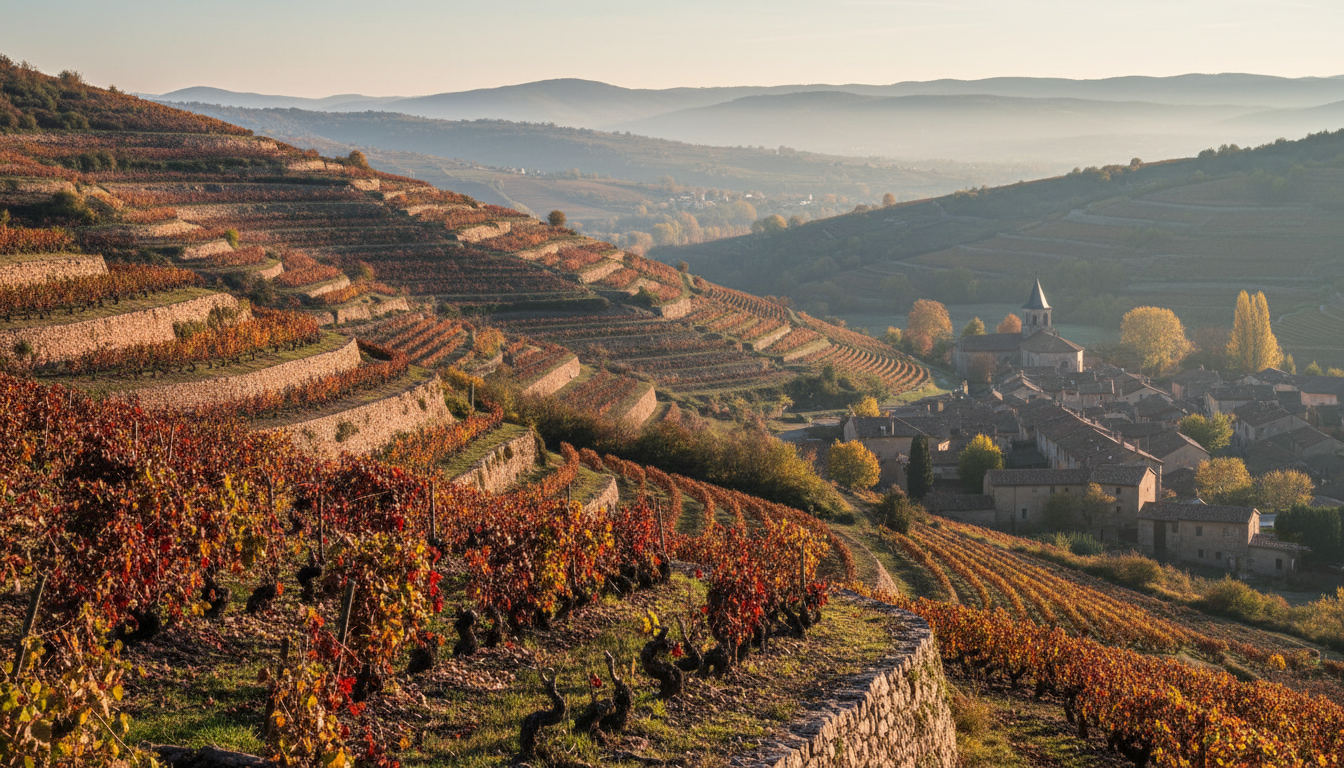
Beaujolais sits at the southern end of Burgundy, built on granite hills covered in Gamay vines. While Nouveau is made for instant drinking, the region's serious wines — from ten designated Cru villages — are structured, complex reds that can age for years, sometimes decades.
These are wines made by families who've worked the same hillsides for generations. The kind of producers we build relationships with. The kind of wines that reward you for slowing down with them.
Here are the ten Crus, from north to south:
- Saint-Amour — the most northerly Cru. Light, soft red fruit, easy-drinking. Sales spike every Valentine's Day (the name helps), but the wine stands up on its own — a perfect kitchen-island red for a Tuesday evening.
- Juliénas — named after Julius Caesar and carrying some of that weight. Darker fruit, earthier, more serious. Two thousand years of winemaking history on these soils.
- Chénas — the rarest Cru in Beaujolais. Almost impossible to find outside France. Sturdy, mineral-driven wines with a Burgundy-like structure that rewards patience.
- Moulin-à-Vent — the King of the Crus. Full-bodied, tannic, complex. These wines can age 10, 20, even 50 years. If you've ever dismissed Beaujolais as lightweight, a good Moulin-à-Vent will change your mind entirely.
- Fleurie — all elegance. Rose petals, violets, blossom-like red fruit. Serve it slightly chilled on a summer evening in the garden with good company. One of the most charming wines in France.
- Chiroubles — the highest altitude Cru, and the lightest. Delicate red berry fruit, pure and fresh. The perfect gateway into Cru Beaujolais if you're just starting to explore.
- Morgon — bold and scholarly. The second-largest Cru, with granite soils that Gamay loves. Fuller-bodied, fairly tannic, and packed with concentrated fruit. These wines genuinely improve with age.
- Régnié — the newest Cru, only elevated in 1988. Bright raspberry, a touch of spice. Sits somewhere between the freshness of Brouilly and the structure of Morgon.
- Côte de Brouilly — grown on the ancient volcanic slopes of Mont Brouilly. Riper and more serious than its neighbour, with better sun exposure and drainage giving the wines real depth.
- Brouilly — the largest and most southerly Cru. Lively, fruity, crowd-pleasing. The bistro red of Beaujolais — uncomplicated, generous, and always welcome at the table.
Why This Matters
The tragedy of Beaujolais — in Ireland especially — is that the Nouveau craze defined the region for an entire generation. A light, fruity wine that was never meant to be taken seriously became the only thing people associated with the name.
And then the 1984 crash cast a long shadow. For many Irish wine drinkers, Beaujolais became a word tinged with sadness.
But the winemakers of these ten Cru villages have been quietly making extraordinary wine for centuries. Families working granite hillsides, farming with care, bottling wines with real character and soul. The kind of producers we've always championed at Wines Direct — independent, family-run, committed to the land.
Next time you see a Beaujolais on a shelf, look beyond the word “Nouveau.” Look for a Cru name. Pick up a Morgon or a Fleurie or a Moulin-à-Vent. Open it at the kitchen island with someone you love. Take your time with it.
That's the real Beaujolais.
What Cru Beaujolais have you tried? Snap a photo of the bottle and tag us @winesdirectirl on Instagram — we'd love to see what's in your glass.
Gav & Gareth Keogh, Wine Brothers | Wines Direct