
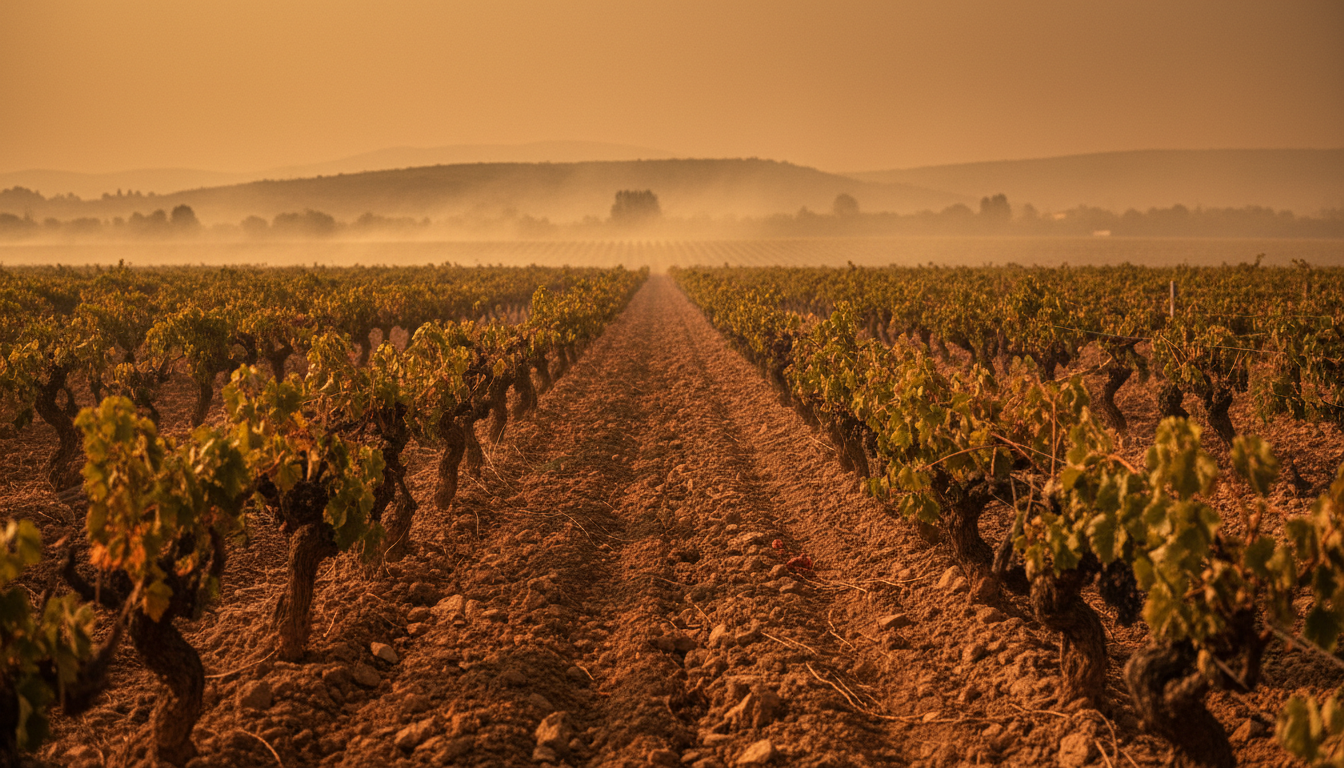
Right now, across vineyards in France, Spain, Italy, and beyond, winemakers are picking grapes weeks earlier than their parents ever did.
And many of them are watching smoke on the horizon while they do it.
This year's European harvest is one of the most dramatic in living memory. It's a story of record-breaking heat, devastating wildfires, and small family producers doing everything they can to protect the fruit they've spent a full year nurturing.
Here's what's actually happening — and why it matters for the wine in your glass.
Harvest Has Never Started This Early
The 2026 vintage is rewriting the calendar.
In Champagne, picking began around August 15th — the earliest on record, smashing the previous mark of August 17th set in 2020. Some plots in Montgueux started as early as August 10th. For context, the earliest documented Champagne harvest before the modern era was August 20th, back in 1822.
In Bordeaux, the main harvest kicked off in mid-August — traditionally a September affair.
In Piedmont, Italy, picking was 7 to 10 days ahead of last year. In Spain's Penedès region, the historic house Juvé & Camps harvested on July 27th — the first time in their hundred-year-plus history that picking happened in July.
The cause? Three separate heatwaves rolled across Europe between May and July. France recorded its hottest day on record on June 24th, with a national average of 30°C. Ground temperatures in some Bordeaux vineyards approached 50°C.
When it's that hot, grapes ripen fast. Sugar levels spike. Acidity drops. And if a winemaker doesn't pick at exactly the right moment, the balance that makes a wine sing just disappears.
The Fires
This is the part that's hard to read.
Since the start of 2026, over 465,000 hectares have burned across southwest Europe — an area roughly the size of County Galway, four times over.
France alone has seen 116,000 hectares go up, surpassing the previous record year of 2022 (66,300 hectares). Over 13,500 fires have been reported since summer began. In the Gironde — Bordeaux's backyard — the fires were the largest since 1949. Flames advanced within 15 kilometres of the city. 220,000 people were evacuated.
Spain has been hit even harder. Over 170,000 hectares burned by late July, including a fire in Ávila described as the largest in recent Spanish history.
Between them, France (740,000 vineyard hectares) and Spain (919,000 vineyard hectares) account for roughly 29% of the world's wine output. That's not a minor footnote. That's the engine room.
Smoke Taint: The Invisible Threat
Here's something most people don't know. A vineyard doesn't need to burn for fire to ruin its wine.
Smoke taint is the hidden damage. Wildfire smoke contains volatile compounds called phenols — particularly one called guaiacol. These compounds are absorbed through grape skins, where the vine locks them up with sugars. The fruit tastes perfectly clean on the vine.
But then fermentation breaks those bonds back open. And the wine tastes of ash, Band-Aid, burnt rubber. It's unsellable.
The worst part? It's unpredictable. Ash was documented falling over 100 kilometres from the fire source in Libourne, near Saint-Émilion. Weather patterns can carry smoke across entire regions. A vineyard 50km from a fire might be devastated by taint while one 5km away escapes completely — it depends on wind, temperature, and timing.
Red wines are more vulnerable because the skins stay in contact with the juice during fermentation. And grapes are most susceptible from véraison (when they change colour) through to harvest — exactly the stage Europe's vineyards were at when the fires peaked.
There are no protective sprays. No quick fix. The only detection method is lab testing before harvest, and even then, the full extent often doesn't reveal itself until the wine is made.
Jacques Lurton, a Bordeaux vintner, put it bluntly: “2026 will be another difficult year for the yields and the production costs.”
The Bigger Picture: This Isn't a One-Off
It's tempting to treat 2026 as a freak year. It isn't.
France's 2025 harvest was already 16% below its five-year average. Spain's was 15% below. The EU has warned that wine production across the bloc will decline by 0.5% every year through to 2035, with vineyard areas contracting by 0.6% annually.
A study published in the Proceedings of the National Academy of Sciences found that if temperatures rise by 2°C, viable wine-growing regions worldwide could shrink by more than half — 56%.
Southern and western Europe has experienced nearly five times more extreme heat days compared to 1980 levels.
Climate change is pushing French wine production northward. Regions that were too cold a generation ago — parts of Normandy, Brittany, even southern England — are now producing viable vintages. Meanwhile, traditional powerhouse regions in the south are fighting to survive.
Hungary's winemakers have been struck by drought and the arrival of Flavescence dorée, a vine disease spread by the American leafhopper that's now present in every Hungarian wine region. Their harvest started two to three weeks early, and wild deer and boar have been devastating vineyards around Lake Balaton as they search for water.
This is happening everywhere. All at once.
What Does This Mean for Wine Prices?
Let's be straight about it.
When supply drops and costs rise, prices follow. It's not a question of if — it's a question of when and by how much.
Here are the pressure points:
- Smaller yields mean less wine per hectare. Bordeaux is looking at 20% or more reduction in volume. Champagne has capped yields at 8,800 kg/ha — roughly 250 million bottles, a 10% year-on-year reduction.
- Smoke taint could render entire parcels unusable, and the full damage won't be clear until after fermentation.
- Production costs are rising — earlier harvests mean compressed timelines, labour pressure, and higher energy costs for temperature-controlled winemaking in extreme heat.
- France exported €11.2 billion worth of wine in 2025. Spain exported €3 billion. Any disruption at that scale ripples through the global supply chain.
Industry analysts at Mintel have flagged that rising temperatures force earlier harvests to avoid excessive sugar content, risking inconsistent alcohol levels and taste profiles — a quality control headache on top of a supply problem.
The honest answer? Expect tighter supply and upward pressure on prices, particularly in premium European wines. Bulk wine contracts are already under strain. The effects will filter through to retail shelves over the next 12 to 18 months.
Why Small Producers Matter More Than Ever
Here's where this connects back to what we do at Wines Direct.
Every bottle we import comes from a small, independent, family-run winemaker. We've tasted every wine with the producer before it goes on our shelves. Many of these relationships are 30 years deep — started by our parents and now continued by us and the next generation of winemakers' children.
These are real people. Families. And right now, they're out in their vineyards at dawn, picking grapes before the heat of the day, testing for smoke taint, watching their yields shrink, and doing everything in their power to make something beautiful from a brutal season.
Sophie Courtois at Château Rasque in Provence, after losing vines directly to fire, said she'd have to “examine the yield parcel by parcel.” She's not one of our producers, but that quote captures exactly what's happening across every wine region right now. Not spreadsheets and insurance claims. Walking the rows, vine by vine.
Our own winemakers are living through the same thing. These are families we've known for decades — relationships our parents started over 30 years ago that have passed to the next generation on both sides. Their children grew up visiting Mullingar. Our family grew up visiting their vineyards.
When you buy wine from producers like these — people who farm responsibly, who've been practising minimal-intervention methods before those terms were even fashionable — you're supporting the kind of agriculture that's built to adapt. Smaller plots. Hands-on viticulture. Deep knowledge of every parcel of land.
That's not marketing language. That's survival.
What You Can Do
Drink with intention. Next time you open a bottle, think about the hands that picked those grapes — probably earlier this year than any year before.
Try something new. As traditional regions face pressure, explore wines from emerging areas. Our producers are adapting, experimenting, and making extraordinary wine in the process.
Don't wait. If there's a wine you love from the 2025 or earlier vintages, the 2026 supply picture is uncertain. The time to stock up is now, not January.
And as always — whatever you're drinking, wherever you're drinking it — snap a photo and tag us @winesdirectirl on Instagram. Whether it's around the kitchen island with friends or out in the last of the September sun, we want to see it.
Gav & Gareth Keogh, Wine Brothers | Wines Direct